

In This Edition
- Geopolitical shifts and rising competition have made domestic investment in innovation, talent and resilient supply chains a critical economic imperative for Canada.
- Insight into key regulatory and policy developments across AI, employment, financial services, and capital markets, plus other need-to-know topics.
- Larger-sized deals in the later stage have been the trend so far in 2026.
Market Insights
Canadian Governments Invest in Innovation, Talent and Domestic Competitiveness — Federal and provincial governments, frequently alongside private-sector partners, have introduced a series of new funding programs, capital sources and talent initiatives designed to support the retention and growth of technology, intellectual property and human capital in Canada. This edition's Market Insight is a summary of recent initiatives that are of particular relevance to companies, founders and investors operating in Canada’s innovation economy.
Read more in our new Blakes Bulletin: Canadian Governments Invest in Innovation, Talent and Domestic Competitiveness.
Legal Update
Founders and investors may find the following insights from our Blakes colleagues helpful and instructive:
- AI Strategy for Canadian Businesses — As Canada pushes AI adoption while tightening rules around privacy, online threats and safe AI use, business owners can learn more about new compliance obligations, funding opportunities and competitive pressures in this Blakes Bulletin: Canada’s AI for All Strategy: Key Takeaways for Businesses.
- Canadian Labour Code — Bill C 31, introduced on May 6, 2026, proposes sweeping amendments to the Canada Labour Code that would largely prohibit non compete clauses and similar post employment restrictions in federally regulated workplaces — subject to limited exceptions — while aligning federal rules more closely with Ontario’s framework and strengthening employee mobility protections. In this Blakes Bulletin: Canada Moves to Restrict Non-Competes in Federally Regulated Workplaces, we explain how the proposed federal amendments reflect a broader legislative trend toward restricting non-compete clauses in the employment context across Canada.
- Canada’s Financial Sector — This article outlines key measures introduced in the 2026 Spring Economic Update and Bill C-30, underscoring their significance in shaping forthcoming reforms to Canada’s financial regulatory framework, particularly with respect to digital assets, financial crime enforcement and the evolving scope of activities permitted for financial institutions. Read more in our Blakes Bulletin: 2026 Spring Economic Update: Key Impacts on Canada’s Financial Sector.
- Procurement — Ontario’s new “Buy Ontario” procurement directive signifies the importance of advancing domestic economic priorities by mandating a clear preference for Ontario and Canadian goods and services across public sector procurements. Learn more in our Blakes Bulletin: Building Local, Buying Local: A Guide to the Buy Ontario Procurement Directives.
- CSA Launches Reporting Pilot Project — The Canadian Securities Administrators’ new semi-annual reporting pilot reduces regulatory burden for smaller venture issuers while maintaining core disclosure and investor protection requirements. Learn more in our Blakes Bulletin: CSA Launches Semi-Annual Reporting Pilot Project for Smaller Venture Issuers.
- Digital Safety Act — On June 10, 2026, the federal government introduced Bill C-34, the Safe Social Media Act. If passed, Bill C-34 would establish a federal digital safety regime by enacting the Digital Safety Act (Act) and creating the Digital Safety Commission of Canada (Commission) through the Digital Safety Commission of Canada Act (the DSCCA). The Commission would be responsible for overseeing and enforcing the Act. Read more in our Blakes Bulletin: Canada’s Digital Safety Act: A Revamped Framework for Online Safety.
Deal Monitor
Data sourced from PitchBook.
- After the spike in 2021, the market has stabilized over the past few years, with 2026 trending to finish around the same mark as 2023, 2024 and 2025 in total deal value. At this point in the year, later-stage deals have generated the most value.
- Information technology continues to stand out as the most active sector, accounting for approximately 41% of total deals in 2026-YTD. Consistent with prior years, healthcare and commercial products and services remain the next most active sectors, together representing roughly 39% of overall deal volume.
- The largest transaction so far in 2026 has been Ontario-based Waabi’s US$850‑million Series C financing, co-led by Khosla Ventures and Uber, underscoring strong investor confidence in its AI-driven autonomous trucking platform and its expansion into commercial deployment and robotaxis. Blakes advised Khosla Ventures, one of Silicon Valley’s leading venture capital firms, on the transaction. Founded by a University of Toronto professor, Waabi is at the forefront of next-generation autonomous trucking technology. In parallel, Blakes also advised on the US$50‑million Series B financing of Toronto-based legaltech startup Spellbook, which provides an AI-powered contract review platform for lawyers.
- Other notable transactions include Nesto’s C$302-million in Series E funding led by Fidelity, Fonds de solidarite FTQ and Diagram Ventures; and Beacon’s US$225-million in Series C funding led by General Catalyst and HarbourVest Partners.
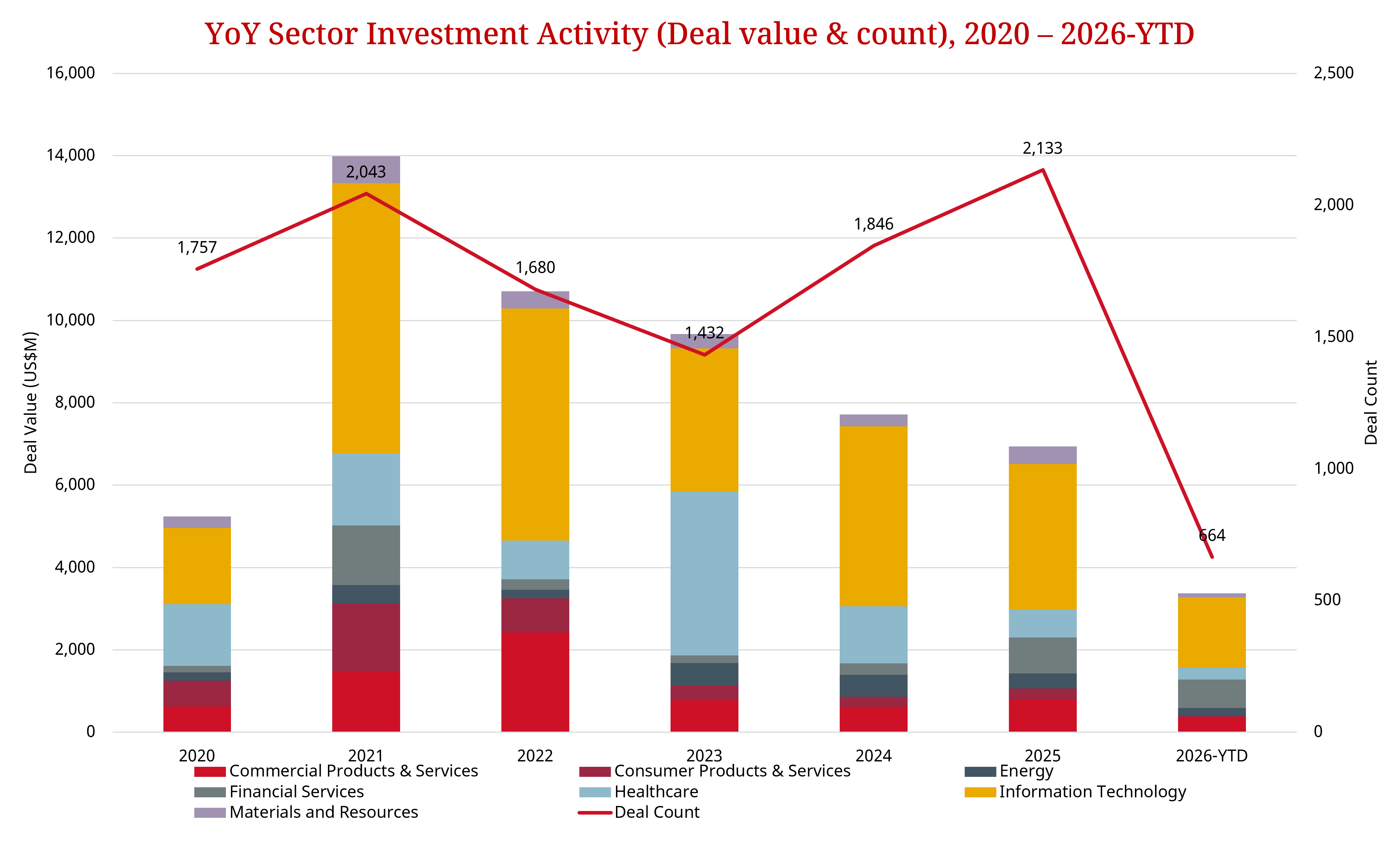
- Roughly halfway through 2026, overall investment value remains resilient, pointing to a market increasingly defined by larger financings. Year-to-date activity suggests that larger deal sizes, particularly in later-stage financing, are contributing more to overall market activity than broad-based deal volume.
Contact Us
If you have any questions, please contact any member of our Emerging Companies & Venture Capital group.
For our recent publicly available experience, visit our website.