
In This Edition
- Key considerations for companies using artificial intelligence (AI) internally.
- Insight into AI and cybersecurity, new federal digital accessibility regulations, emerging FinTech reporting requirements, biometric privacy compliance, proposed updates to Canada’s competition and greenwashing laws, recent cross-border tariff and investment developments, and other need-to-know topics.
- A look at 2025 in the market, and how it stacked up against previous years.
Market Insights
Governing the Internal Use of Artificial Intelligence – Key Considerations — Many studies indicate that more than 70% of companies are making use of AI internally. While these tools can create efficiencies and reduce costs, managing their use within an organization is critical. By their fundamental nature, their use, even casually by companies and their employees, can introduce significant risks that may not be immediately apparent.
Read more in our new Blakes Bulletin: Governing the Internal Use of Artificial Intelligence – Key Considerations.
Legal Update
Founders and investors may find the following insights from our Blakes colleagues helpful and instructive:
- AI Sovereignty for Canadian Businesses — As the world rapidly develops, adopts and invests in AI systems and infrastructure, “AI sovereignty” has emerged as a priority of the Canadian federal government. In this Blakes Bulletin: AI Sovereignty: What Canadian Businesses Need to Know, we explain what AI sovereignty is and related AI considerations that may impact your organization.
- Artificial Intelligence and Cybersecurity — AI and cybersecurity are two areas that share similarly steep growth trajectories, presenting both risks and opportunities to issuers. Directors or officers who may not have similar levels of exposure to these topics may find the baseline technical expertise required to address such issues challenging. Read more in our Blakes Bulletin: Artificial Intelligence and Cybersecurity: Board Oversight Essentials.
- Digital Transformation — On December 5, 2025, the federal government registered amendments to the Accessible Canada Regulations made under the Accessible Canada Act (ACA). These amendments (the Digital Technologies Accessibility Regulations), which generally come into force in 2027 for federal public-sector entities and in 2028 for large federally regulated private-sector entities, add significant digital accessibility compliance obligations for such entities. Learn more in our Blakes Bulletin: Federal Government Finalizes New Digital Technologies Accessibility Regulations.
- FinTech — The Bank of Canada recently conducted an information session and released a detailed guide in anticipation of the upcoming deadline for payment service providers (PSPs) to file their first annual report under the Retail Payment Activities Act (RPAA). Learn more in our Blakes Bulletin: Bank of Canada Outlines Annual Reporting Requirements for Registered PSPs Under the Retail Payment Activities Act.
- Privacy and Data Protection — Businesses are increasingly adopting biometric technologies for a wide range of uses, from controlling access to digital and physical spaces and verifying identity online, to detecting customer sentiments and estimating user ages on social media sites. This trend brings heightened compliance risks across sectors. Read more in our Blakes Bulletin: Biometric Data: Privacy Compliance in Practice.
- Competition Law — On November 18, 2025, the federal Minister of Finance introduced Bill C-15 (Bill) in the House of Commons for first reading. Among other items, the Bill proposes two key amendments to the Competition Act’s recently enacted greenwashing provisions. Read more in our Blakes Bulletin: Federal Government Proposes Revisions to Recently Enacted Greenwashing Provisions.
- Cross-Border Tariffs: Lawsuits and Timeline of Key Dates — The governments of Canada and China have taken a number of significant steps in early 2026 to reset the trading and investment relationship between the two countries. Learn more about these developments in our Blakes Bulletin: Investment Canada Act Update: Canada Opens Door to Greater Investment From China and Expands Global Opportunities. Additionally, we outline key tariff-related dates and documents between Canada and the United States in U.S.–Canada Tariffs: Timeline of Key Dates and Documents.
Deal Monitor
Data sourced from PitchBook.
- In recent investor news, Y Combinator’s decision to resume investing in Canadian-incorporated startups is a strong vote of confidence in Canada’s innovation ecosystem. Re-engagement from one of the world’s most influential startup accelerators reinforces Canada’s role as a critical pipeline for high-impact companies and underscores the importance of maintaining pathways for Canadian founders to access top-tier global capital and networks.
- Similar to 2024, 2025 saw a relatively even distribution of value between early stage, later stage and growth equity deals. Its total deal value is roughly in line with 2023 and 2024, meaning the market is seeing a reset from the 2021 and 2022 excess but has not yet re-entered a growth cycle.
- Information Technology investments were once again the most active industry, comprising nearly half of the top 20 deals and 35% of total deals in 2025. Healthcare, commercial products and services, and consumer products and services investments continue to be very active as well, combining for 51% of total deals.
- Among the largest transactions to date was British Columbia-based Clio’s US$850-million Series G venture funding through a combination of debt and equity on November 10, 2025. The funds will be used to lead the next generation of legal innovation and deliver lasting impact for legal professionals and their clients worldwide.
- Other notable transactions from 2025 include Cohere’s US$700-million of Series D1 funding led by Radical Ventures and Inovia Capital; and Wealthsimple Technologies’ C$750-million of Series E funding led by Dragoneer Investment Group and GIC Private.
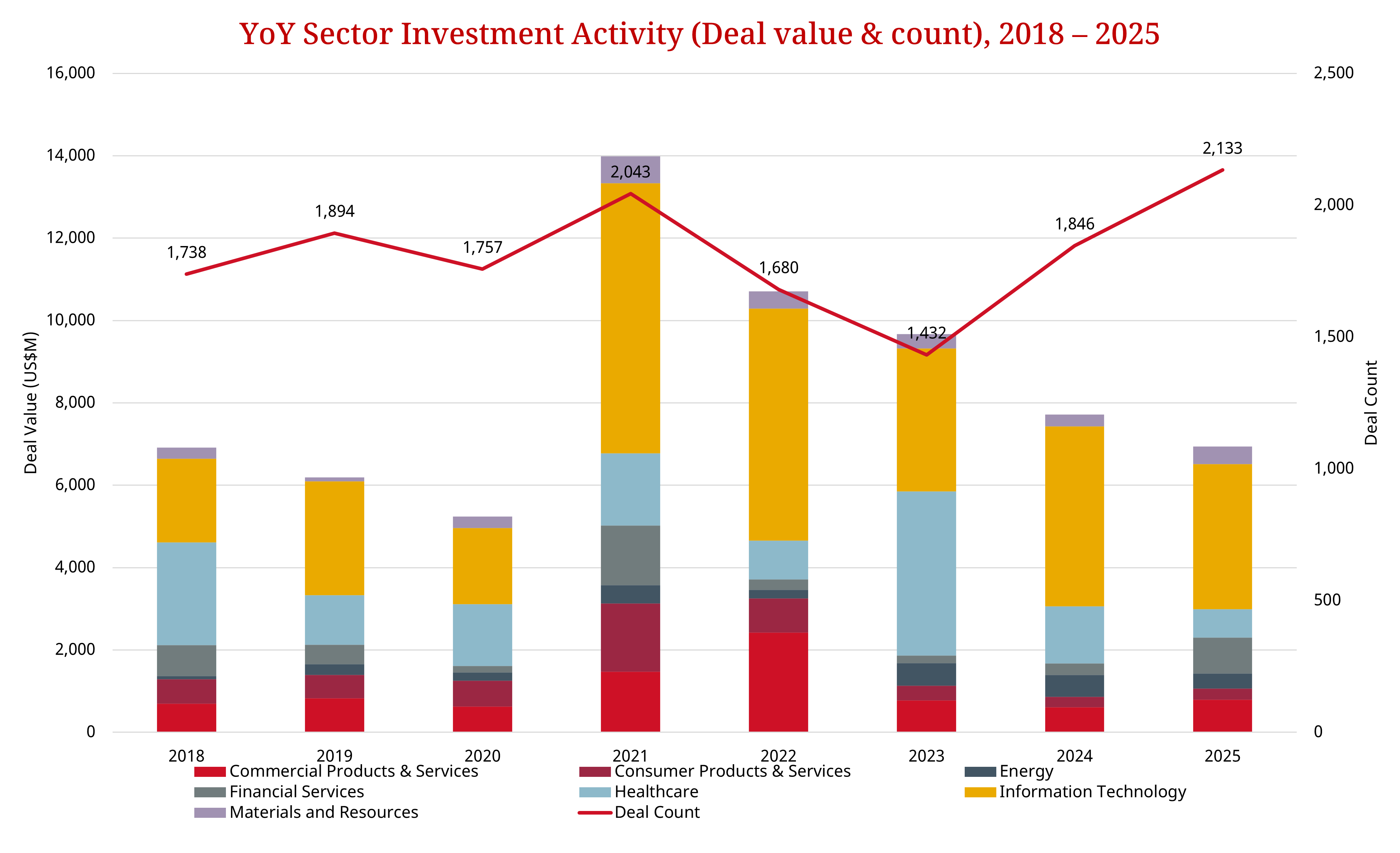
- 2025 saw the highest number of total deals in nearly a decade, meaning investors are doing more deals than ever, but only where capital can be protected, pushing money away from late-stage bets and toward early optionality and growth equity certainty.
Contact Us
If you have any questions, please contact any member of our Emerging Companies & Venture Capital group.
For our recent publicly available experience, visit our website.